
DS-160 Form Sample: Sections, Examples and PDF Guide
A DS-160 form sample can help you understand the information to prepare before starting your U.S. visa application. Use it to organize your own details, recognize the main topics and distinguish a sample PDF from your submission confirmation.
Quick answer: Complete and submit the DS-160 through the official online application. A sample guide is a preparation aid; your confirmation page is the record produced after submission. Start with the Department of State DS-160 overview and the official CEAC application.
DS-160 form sample PDF: which document do you need?
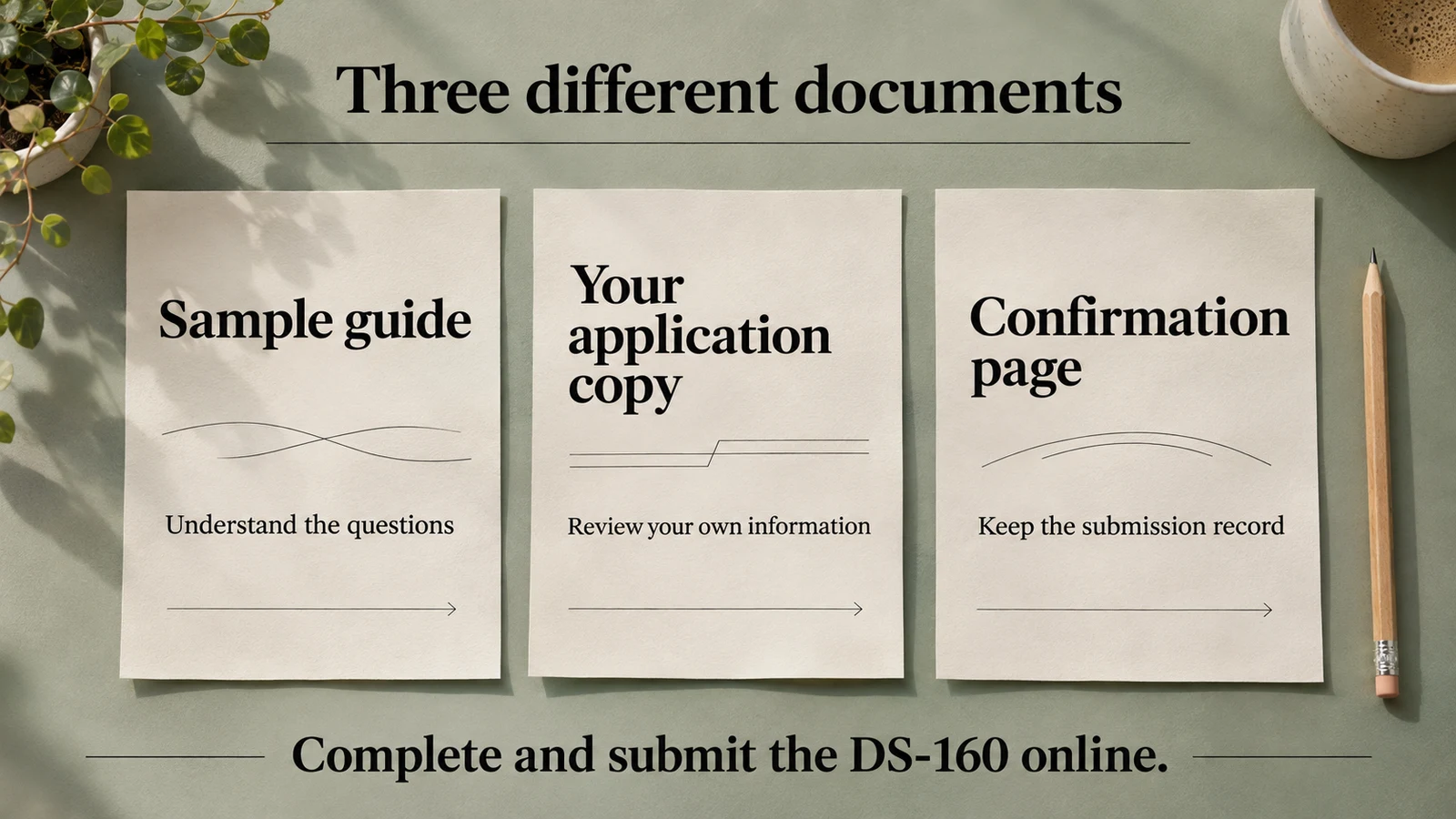
People looking for a DS-160 sample form PDF may be looking for three different things. Identify the document you need before downloading a file or starting again.
| Document | What it helps you do | Important distinction |
|---|---|---|
| A sample or preparation guide | Understand the information and practice organizing your facts | It is not your submitted application |
| A copy of your own application information | Review the details you entered | It contains your information, rather than another applicant’s examples |
| Your DS-160 confirmation page | Keep the submission record and application identification details | It is different from a full copy of your answers |
For a visual reference, USTravelDocs hosts a sample DS-160 confirmation page PDF. It is a one-page confirmation example dated 2018, rather than a current blank application to fill in. Use the live official application for your own submission.
To keep this guide offline, use your browser’s Print option and choose Save as PDF. For your own application record, use the review, save and confirmation functions available in CEAC.
Where to complete the DS-160
The official starting point is ceac.state.gov/genniv. CEAC’s instructions tell applicants to gather their documents and review the guidance before beginning. A PDF you downloaded from another website is not a replacement for submitting the online form.
Set aside a quiet period to work through your information. If a helper assists you, review the entries yourself and resolve uncertainties before reaching the signing step.
Main information areas to prepare
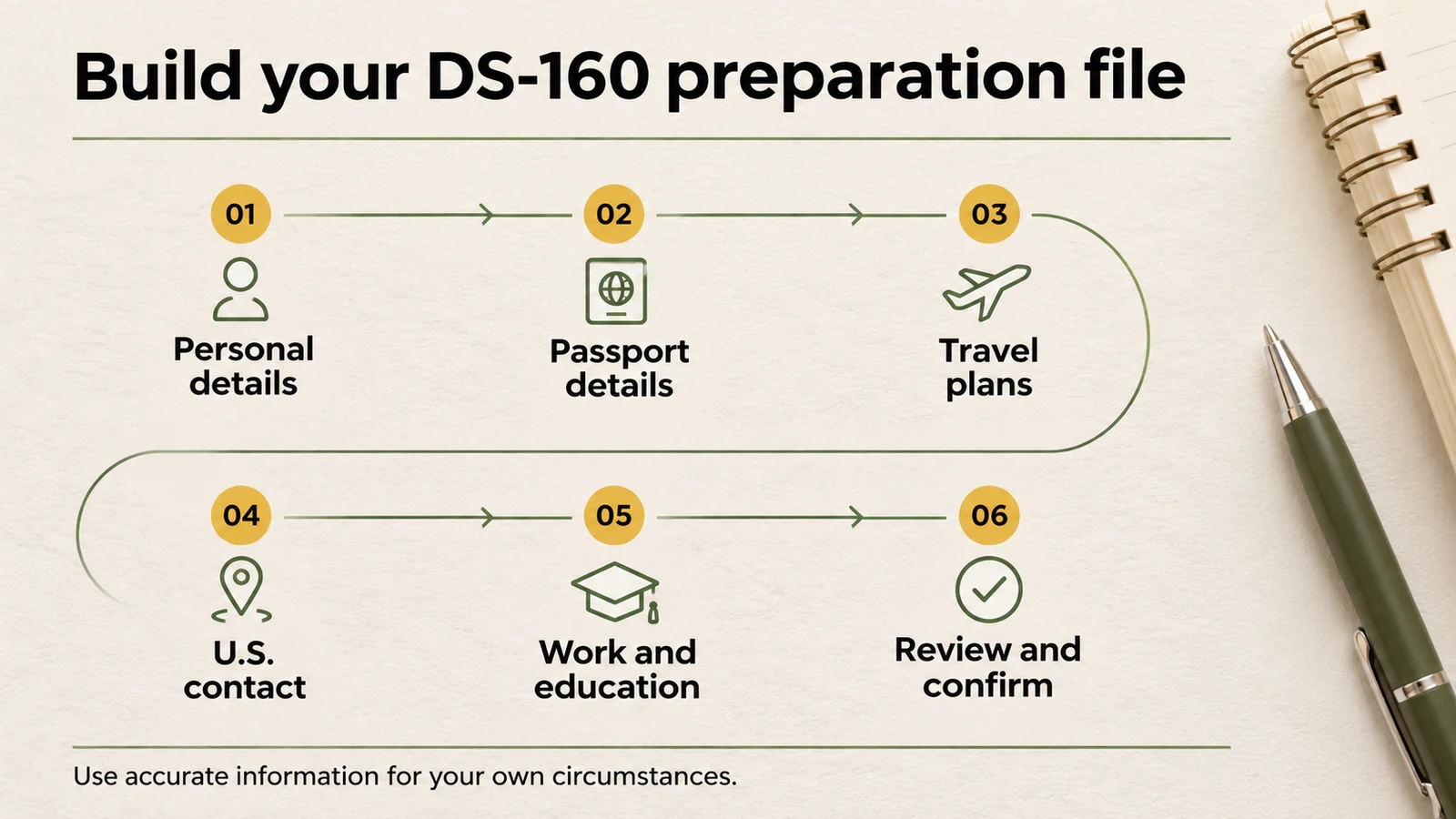
Use the following groups to build a preparation file. This is a practical way to organize your notes; follow the questions and instructions shown for your own application.
| Preparation area | Information to organize | Your review check |
|---|---|---|
| Personal details | Names, birth details and nationality information | Compare the entries with your identity documents |
| Passport details | The travel document you intend to use | Copy numbers and dates carefully |
| Travel plans | Purpose, intended dates, accommodation and funding | Separate confirmed arrangements from proposed plans |
| U.S. contact information | The relevant person or organization for your circumstances | Confirm details instead of guessing them |
| Work and education | Your relevant present and past information | Check names, roles and dates against your records |
| Application review | The completed answers and any unresolved questions | Read each answer before signing |
The State Department’s FAQ identifies documents such as a passport, travel information and relevant work history as useful preparation materials. Additional information depends on your travel purpose. Review the official preparation FAQs.
DS-160 sample: organizing a visitor’s trip information
Consider a hypothetical visitor planning a two-week family visit and sightseeing trip. The notes below show a useful level of preparation. They are not exact form responses to copy: enter your own facts in the fields the application presents.
| Topic | Example preparation note | What you should verify |
|---|---|---|
| Travel purpose | A personal visit to a sister, with sightseeing during the stay | The activities you actually intend to undertake |
| Expected duration | Approximately two weeks during approved leave | Your proposed dates and current commitments |
| Accommodation | Staying at the sister’s home | The actual host and address |
| Trip funding | The visitor pays for flights and personal spending; the host provides accommodation | The real arrangement for each cost |
| Travel companion | Traveling with a spouse | Who will actually accompany you |
| Work information | Current employer details and the dates of employment | Your records, rather than estimated dates |
Writing these notes can reveal gaps before you start. For instance, “my family will help” may leave you uncertain about who pays for a flight or where you will stay. Resolve those practical details with the people involved, then enter accurate information.
If you are unsure whether your trip is primarily a business visit or personal visit, read our B1 vs B2 visa comparison before describing your plans.
Saving your work and returning later
The State Department explains that an application ID is needed to return to a partially completed DS-160. Its FAQ describes the 30-day return window and a separate option for saving an application file to your computer. Keep the ID and follow the current save and retrieval instructions. Official saving and retrieval guidance.
Keep a simple personal checklist of the sections you reviewed and any details still needing confirmation. Do not treat a browser tab left open as your only record of progress.
Review before you sign and submit
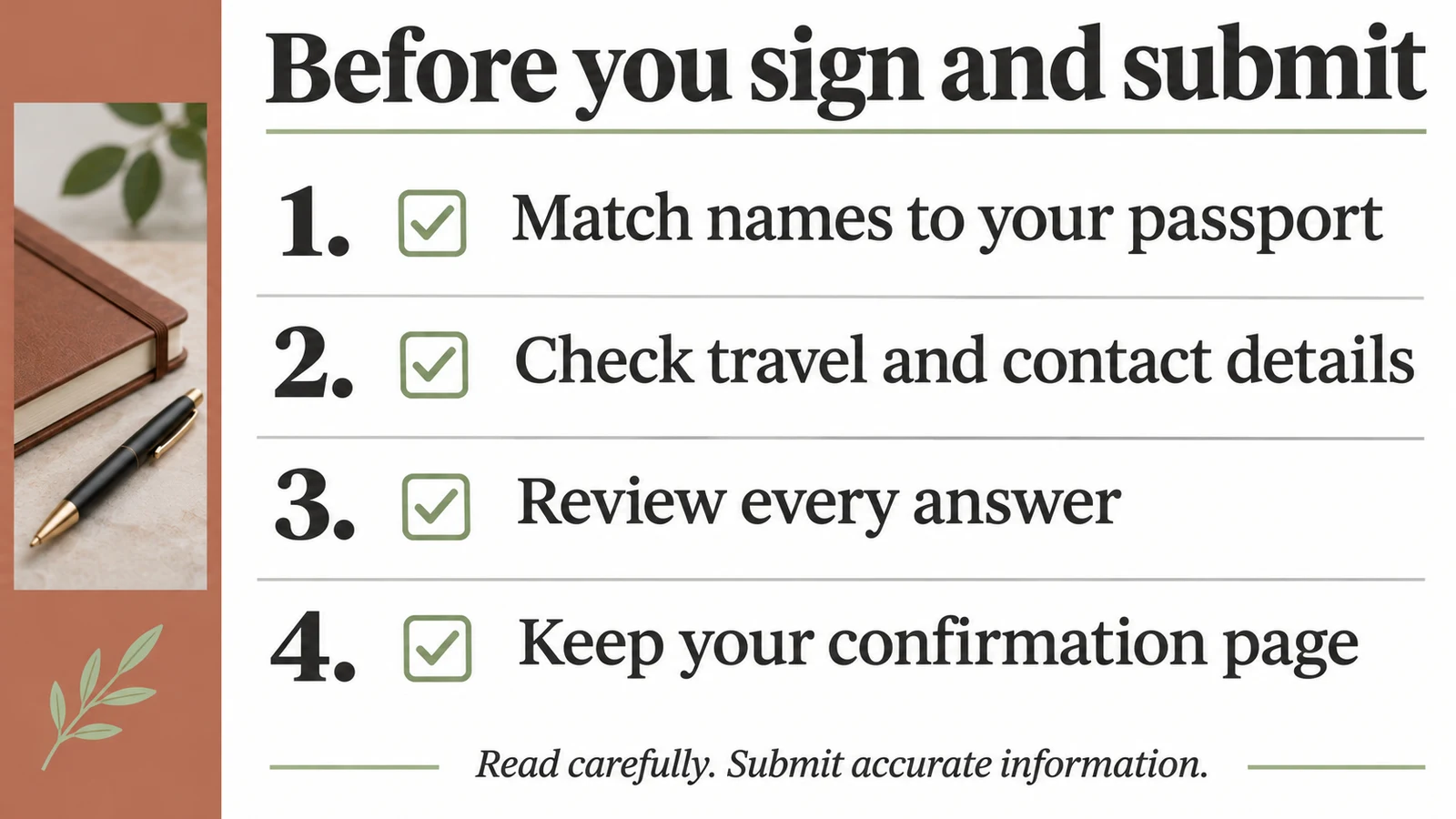
Work through your review in a consistent order:
- Compare identity and passport details with the document you will use.
- Recheck the purpose, timing and practical arrangements of your trip.
- Review contact details and relevant work or education information.
- Read every answer, including information entered by a helper.
- Resolve uncertain information before submitting.
CEAC explains that applicants generally must electronically sign and submit their own application, even when someone else helped complete it, unless an exemption applies. Follow those instructions at the signing stage. Official CEAC instructions.
What to keep after submission
The State Department’s DS-160 overview tells applicants to print and keep the barcode confirmation page. It also directs applicants to the relevant embassy or consulate for subsequent appointment and fee instructions. Submission alone is not the end of the visa application process. Official next steps after DS-160 submission.
Keep your confirmation page somewhere you can locate it alongside your other application records. Before an interview, compare the consulate’s current document checklist with what you have prepared.
Common mistakes when using a form sample
- Copying another person’s details: Use examples to understand the question, then answer for yourself.
- Confusing a confirmation PDF with the application: Identify the document before deciding what to download or print.
- Treating old screenshots as current instructions: Follow the live form and the embassy’s guidance.
- Guessing dates or contacts: Check your records or ask the relevant person.
- Skipping the final review: A helper’s involvement is a reason to review carefully, not to skip reading the answers.
For visitors, the State Department lists the DS-160 confirmation page among the required interview documents. Check the consulate’s instructions for the rest of your checklist. Visitor visa document guidance.
Frequently asked questions
Can I fill in a DS-160 form sample PDF and submit it?
Use the official online DS-160 for submission. A sample PDF can help you prepare or recognize a document, but it does not replace the online application. Official DS-160 overview.
Is the confirmation page the same as the full application?
No. The confirmation page records submission and identifies the application. The State Department says you need the confirmation page, rather than the entire application, for the interview. Confirmation page FAQs.
What if I lose my confirmation page?
The official FAQ describes retrieving a submitted application through CEAC and reprinting its confirmation page using the application ID. Follow the instructions for your application. Reprinting instructions.
Should everyone use the same example answers?
No. Your preparation should reflect your own travel, identity and history. Work through each question as it applies to you instead of adapting your circumstances to match a sample.
Need help organizing your DS-160 information?
Explore our DS-160 preparation assistance or compare service packages. If an interview is your next step, our B2 interview preparation guide can help you organize your trip details. US Visa Desk is a private assistance service; visa decisions remain with U.S. authorities.